
In the past few decades, automotive technology has vastly improved, further advancing and transforming the way vehicles operate. Today’s cars rely on electrical systems more than ever before. These systems help your vehicle start, power your accessories, manage engine operation, and communicate important information to you, the driver. In this article, we’ll walk through the main electrical components in a car, including the battery, alternator, starter, fuses and relays, sensors, and engine control module, along with the signs that something may be wrong.
What Are the Main Electrical Components in a Car?
Battery
Modern car batteries power the starter motor, car radio, and everything in between. Without it, your car is nothing more than a non-movable clump of metal. But how does the battery power the vehicle?
Each cell contains a lead dioxide plate and a lead plate, producing about two volts per cell, or 12 volts across a typical six-cell battery. The plates are submerged in sulfuric acid, triggering a chemical reaction that produces ions and lead sulfate. As the ions move between the plates, they generate electricity that flows through the battery terminals to power the starter motor and other electrical systems.
In short, the battery stores electrical energy and provides the initial power needed to start your vehicle. It also supplies electrical power when the engine is off, which is why you can still listen to the radio or turn on your lights while parked. Most vehicles use a 12-volt lead-acid battery.
Car Battery Common Problems:
- Battery won’t hold a charge
- Corroded terminals
- Swollen or leaking battery
- Weak/slow starting
A car that won’t start isn’t always a dead battery. Corroded or loose terminals can cut off power even when the battery itself is fine, which is why we always test the battery and inspect the connections before recommending a replacement.
Alternator
When it comes to powering your car’s radio and other electronic components, you may think that’s all the battery pulling the weight. In reality, once the engine is running, it’s the alternator supplying power to key components like headlights, dashboard lights, and other electrical features. It also recharges the battery as you drive, so the battery is ready for your next start.
The alternator functions through a belt connected to the engine, which spins a rotor inside the alternator. This motion creates alternating current (AC), which is converted into direct current (DC) to power your car’s electrical systems.
Common Problems With The Alternator:
- Battery warning light
- Dimming/flickering lights
- Weak battery
- Vehicle may eventually stall
A failing alternator is often mistaken for a bad battery, because a weak alternator leaves the battery undercharged and the car struggles to start. Replacing the battery without testing the charging system can mean being stranded again a few weeks later.
Starter
Starter motors are essential in getting your car engine running. When you turn the ignition key or push the start button, the starter motor receives electrical power from the battery. This power activates the motor, which then turns a small gear. That gear engages the engine’s flywheel and spins the engine until combustion begins and it can run on its own. Once the engine is running, the starter disengages.
Common Starter Motor Issues:
- Engine won’t start
- Clicking noise
- Starter motor doesn’t turn
- Smell of smoke
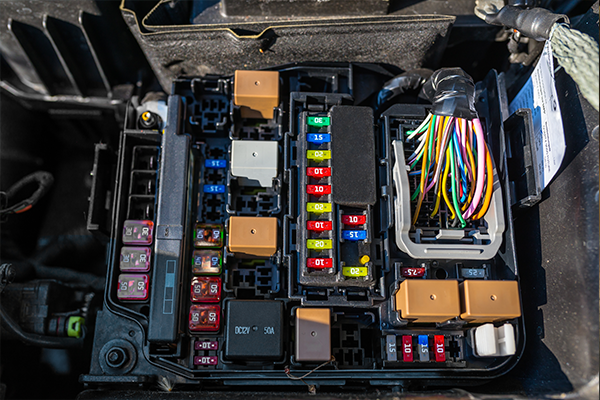
Fuses and Relays
Fuses protect electrical circuits from excessive current. When too much current flows through a circuit, the fuse blows, cutting off power before wiring or components can be damaged. Relays act as electrically controlled switches that allow a low-current circuit to control a higher-current component, like your headlights or fuel pump.
If a fuse is repeatedly blown, it can indicate an underlying electrical problem you should have checked out sooner rather than later. Simply replacing the fuse again won’t fix the root cause.
Examples of systems that may use them include:
- Lights
- Fuel pump
- Cooling fans
- HVAC systems
Other Important Electrical Components
Sensors
Modern vehicles use various sensors to monitor engine and vehicle conditions. These sensors constantly send information to the vehicle’s computers so systems can make adjustments in real time, helping your car run efficiently, stay safe, and keep emissions low.
Types of Sensors in Your Vehicle:
- Oxygen sensors
- Mass airflow sensor
- Coolant temperature sensor
- Wheel speed sensors
Engine Control Module (ECM)
The ECM is one of the vehicle’s primary computers. It processes vital information from sensors and assists control systems such as fuel injection, ignition timing, and emissions systems. As technology improves, you may find other modules controlling different vehicle systems in modern cars, from transmissions to braking and safety features.
Signs of an Electrical Problem
Electrical problems can originate from the battery, alternator, wiring, connections, fuses, or another component, so getting a proper diagnosis is important when it comes to the next course of action.
Signs You May Have an Electrical Problem:
- Difficulty starting
- Dimming or flickering lights
- Battery warning light
- Electrical accessories not working
- Blown fuses
- Warning lights appearing on the dashboard
- Unusual electrical smells or burning odors
Keep Your Car’s Electrical System Working Properly
If your vehicle is experiencing any of these symptoms, it’s a good idea to have it inspected by a trusted automotive professional to avoid further issues and potential damage. With over 60 years of experience, the team at Pohlman’s Auto & Tire Center has the training and expertise to diagnose even the most complex electrical issues and deliver top-notch electrical maintenance and repair, no matter what you drive. Give us a call or schedule with our friendly team online today.